Watch With Your Kids: The Bright Swimsuit Cartoon
Our 2-minute cartoon shows why swimsuit color matters. Tilly's new navy swimsuit makes her hard to find in the pool, and Buoy the capybara explains what to do differently. The rule to say together: bright suit, easy to see!
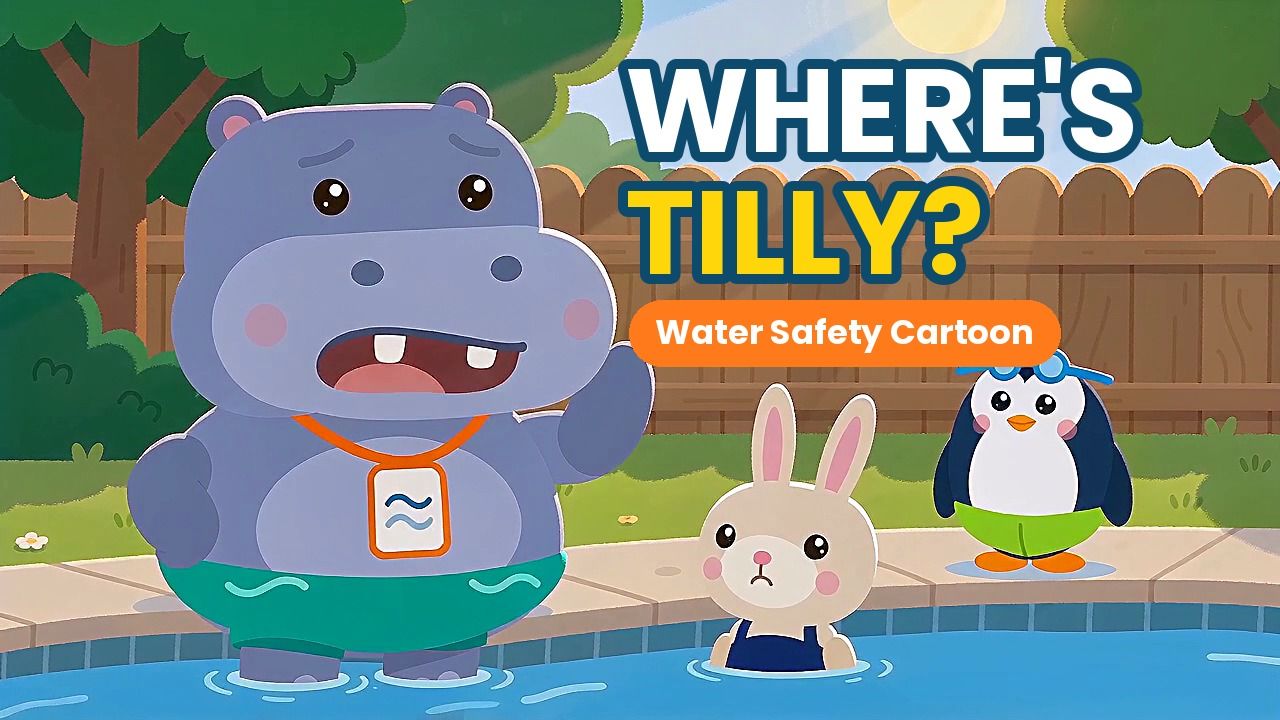
Runs 2 minutes 40 seconds, with captions. Made with AI animation tools and reviewed by people. See all our water safety cartoons.
Why Does Swimsuit Color Even Matter for Water Safety?
Bright, high-contrast swimsuit colors help rescuers locate a child in trouble faster—every second counts in a water emergency.
It sounds almost too simple to matter—what does color have to do with whether a child stays safe in water? But water safety experts and drowning prevention organizations like the CDC and American Red Cross take this seriously because the science is clear: visibility saves lives.
When a child is struggling or in trouble in water, every second counts. The faster rescuers can locate them, the better the outcome. This is true whether the rescuer is a lifeguard, a parent, or emergency personnel responding to a call. A bright swimsuit creates immediate visual contrast that makes a child stand out. A dark swimsuit blends into the water, especially at a distance or in less-than-perfect conditions.
This isn't theory—water safety organizations have researched and documented this. The principle is simple: bright colors save lives because they reduce the time it takes to spot a child who needs help. While constant supervision is absolutely your primary protection, swimsuit color is an inexpensive, easy addition to your water safety strategy.
What Does the Research Actually Show About Water Visibility?
Visibility testing by water safety organizations shows neon colors like hot pink and lime green are spotted far faster and at greater distances than dark colors like navy or black.
Studies on water visibility have examined how different swimsuit colors perform in various water conditions. The findings consistently show significant differences in visibility based on color.
Research from water safety experts, including studies conducted at the University of Southern California and data compiled by water safety organizations like Alive Solutions, demonstrates that bright colors—especially neon colors—are spotted much faster and at much greater distances than dark colors.
Most visible colors in order of visibility:
- Neon/Electric colors: Hot pink, lime green, electric orange, bright yellow (most visible)
- Bright colors: Regular hot pink, orange, yellow, white
- Medium colors: Red, blue, green
- Dark colors: Navy, black, dark brown, dark green (least visible)
The difference is remarkable. In studies, neon pink and lime green were spotted from farther away and in less time than navy or black swimsuits. This matters in pools, but it matters even more in open water where waves, glare, and distance are factors.
How Does Color Visibility Differ in Different Water Types?
Neon hot pink and lime green work well across all water types—pools, lakes, and oceans—while dark colors are dangerously low-visibility in every environment.
The water type makes a difference in how visible colors are. Your best choice depends partly on where your child swims most often.
In chlorinated pools: Clear water with consistent lighting. Most bright colors are easily visible. Even medium colors like red or white work reasonably well. However, dark colors still stand out much less. For pools, prioritize any bright color, but neon provides optimal visibility.
In lakes and rivers: Water clarity varies greatly. Many lakes have murky or greenish water that makes colors harder to distinguish. In these conditions, colors that contrast sharply with greenish water are best. Lime green and hot pink both work exceptionally well, as they provide strong contrast. Avoid any greens or dark colors that blend with the water. Orange and yellow also work well.
In the ocean: Salt water, waves, and distance make spotting more challenging. The water's blue color means colors that contrast strongly with blue are best. Hot pink, orange, and neon yellow provide the strongest contrast against ocean water. Even with strong sunlight and white-cap waves, bright colors cut through. Dark colors are dangerously poor visibility in ocean conditions.
In variable conditions: If your child swims in multiple environments, neon hot pink and lime green are your safest bets because they work well in pools, lakes, and oceans.
What About Neon Versus Regular Bright Colors?
True neon (fluorescent) colors are engineered to appear to emit light, making them significantly more visible than standard bright colors.
There's a difference, and it matters. Neon is not just a marketing term—it's a category of color that is specifically engineered to be highly visible.
Neon colors (true neon) are created with fluorescent dyes that actually glow under light. They appear to emit light rather than just reflect it. This gives them a distinctive appearance and superior visibility compared to regular bright colors.
Examples of true neon:
- Neon pink (also called hot pink, electric pink, or fluorescent pink)
- Neon yellow (also called fluorescent yellow or electric yellow)
- Neon orange (also called fluorescent orange or electric orange)
- Neon green (also called lime green, electric green, or fluorescent green)
Regular bright colors that are good but not neon:
- Regular bright pink (less vibrant than neon)
- Regular red
- Regular bright blue
- Regular orange
When shopping, look for swimsuits labeled as "neon," "fluorescent," "electric," or with names like "hot pink" or "lime green." These are the true attention-getters. Regular bright colors are acceptable and much better than dark colors, but neon is the gold standard.
Does Pattern or Design Affect Visibility?
Yes—solid bright colors are more visible than patterned suits because patterns break up the visual outline, making a child harder to spot from a distance.
Yes, significantly. A solid bright color is more visible than a patterned suit with the same base color.
When you add patterns, stripes, or designs, you create visual interruption. Your brain processes solid colors as one cohesive unit, making them easier to spot quickly. Patterns break that visual unity and can make a child harder to detect, especially from a distance.
Pattern visibility guidelines:
- Best: Solid bright or neon color (no patterns)
- Good: Bright base color with small, non-contrasting design (small logo on chest)
- Acceptable: Bright base color with subtle stripe or pattern
- Poor: Dark base color with bright design (the dark dominates visibility)
- Worst: Dark solid color or busy patterns on dark base
If you're buying a patterned swimsuit, make sure the base color is the priority. A bright pink suit with a small white design is fine. A navy suit with bright pink designs is not safe. The dominant color is what rescuers will see first and from a distance.
What About Rash Guards and Other Swim Apparel?
Apply the same bright-color logic to rash guards, swim shirts, and board shorts—the most prominent visible color should always be bright.
If your child wears a rash guard over their swimsuit, apply the same color logic. The rash guard should be bright, not dark. In fact, rash guards are often worn specifically for sun protection, and many come in vibrant colors, which conveniently makes them safe for visibility too.
If your child wears a swim shirt, board shorts, or other apparel, ensure the most prominent color is bright. Avoid the combination of a dark swimsuit under a bright rash guard if the dark swimsuit shows—the swimsuit color is what matters in the water.
Some children with sensory sensitivities or other needs might wear solid-color rash guards. If that's your situation, choose the brightest color available and discuss water supervision strategies with your family to compensate.
Does Swimsuit Color Replace Life Jackets?
Absolutely not. A bright swimsuit improves visibility but provides no flotation—a Coast Guard-approved life jacket is non-negotiable for non-swimmers.
Absolutely not. Never consider swimsuit color a substitute for a properly fitted life jacket for non-swimmers or weak swimmers.
The American Academy of Pediatrics (HealthyChildren.org) stresses that close, constant adult supervision is the foundation of water safety, and that even strong swimmers need life jackets in open water. A life jacket is critical flotation that can be the difference between life and death if a child becomes exhausted or panics. A bright swimsuit does not provide flotation; it only improves visibility. For children who are not yet strong swimmers, a Coast Guard-approved life jacket is non-negotiable, especially in open water.
A bright swimsuit + a life jacket in a bright color is actually optimal. Many life jackets come in orange, yellow, or red, which adds another visibility layer. But the jacket itself is the lifesaving device; the color is just optimizing that protection.
What About Competition or Swim Team Swimsuits?
For team-required darker suits, use bright colors for practice and all non-competition water time, and ask your coach about bright rashguard options.
If your child is on a swim team, they may be required to wear a specific team suit with team colors. This is one context where you might need to prioritize team requirements over optimal color safety.
However, consider these options:
- Check if your team has multiple suit options and choose the brightest one available
- Ask your team if they'd accept a bright rashguard over a darker suit
- For practice sessions, prioritize visibility (bright suit) over team colors
- For meets, follow team requirements but ensure your child wears bright colors for any non-competition water time
- Talk to your coach about the importance of visibility for safety
Most swim coaches understand water safety and may be willing to work with you on this. At minimum, any off-team water activities should prioritize bright colors.
How Should You Choose a Safe Swimsuit for Your Child?
Choose color first (bright or neon), ensure any pattern has a bright base color, and verify visibility in natural daylight before buying.
Ready to put this into practice? Here's what to do when choosing or replacing your child's swimwear:
- Step 1: Choose color first. Before looking at style, fit, or design, select a suit in a bright or neon color.
- Step 2: Make the base color bright. If the suit has a pattern, ensure the dominant color is bright, not dark.
- Step 3: Check visibility in natural light. Look at the suit in daylight or outside, not just under indoor lighting. This is closer to how it will appear in water.
- Step 4: Avoid dark base colors. Navy, black, dark green, and dark brown are not acceptable as primary colors, even if they have bright accents.
- Step 5: Consider the water environment. If your child swims primarily in open water, prioritize neon colors. For pool-only swimming, any bright color works.
- Step 6: Make it a habit. When any swimsuit needs replacement, choose bright color again. Make this your family's standard practice.
Why Does Choosing the Right Swimsuit Color Matter?
A bright swimsuit adds a zero-cost layer of protection to your water safety strategy by reducing the time rescuers need to spot a child in trouble.
Choosing a bright swimsuit takes maybe an extra minute of thought when shopping. It costs the same or sometimes less than a dark suit. It requires no special skills or equipment. Yet it can genuinely improve the chances that your child will be spotted quickly if they ever need help in water.
Water safety is built on layers. You provide supervision, your child learns to swim, you ensure CPR-trained adults are present, you establish safety rules, you use life jackets when appropriate. A bright swimsuit isn't the most important layer—constant supervision absolutely is. But it's a simple, inexpensive addition that optimizes your protection strategy. The National Drowning Prevention Alliance recommends designating a dedicated Water Watcher who keeps eyes on swimmers at all times—bright swimwear makes that watcher's job easier.
According to CDC Drowning Facts, drowning is the leading cause of unintentional injury death for children ages 1–4, with about 4,000 fatal drownings—roughly 11 per day—in the U.S. each year (2012–2021 average), including nearly 970 children. The CDC also notes that drowning is often silent and fast, which is exactly why faster visual detection matters. Every drowning prevention expert agrees: bright colors save lives. Make it part of your family's water safety routine.
Want to strengthen your overall water safety strategy beyond swimsuit color? Read our comprehensive guide to drowning prevention. Learn what to watch for with our article on the signs of drowning. Establish family water safety rules with help from our pool safety checklist. For open water activities, check out our guide to lake and ocean safety. And make sure every caregiver knows about proper life jacket selection and use to build the strongest protection possible for your child.
Color is the swimsuit decision that matters most, and it is one line on our free printable kids’ swim gear fit check, which tests every other piece of gear your child wears in the water and tells you when each one needs replacing.
📚 Authoritative Sources
- CDC Drowning Facts: national drowning data showing it is the leading cause of unintentional injury death for ages 1–4 and that drowning is silent and fast—context for why rapid visual detection matters.
- American Academy of Pediatrics (HealthyChildren.org): pediatric guidance on close, constant supervision of young children around water—the primary layer a bright swimsuit supports.
- National Drowning Prevention Alliance: the Water Watcher program and layered-protection approach that pair naturally with high-visibility swimwear.
- American Red Cross Water Safety: core water safety practices for families, including supervision and life jacket use alongside visibility.