In this guide (9 sections)
Watch With Your Kids: Weekend with Nana Flo Cartoon
Our 2-minute cartoon shows what goes wrong when nobody hands over the details. Gus leaves the kids with Nana Flo for the weekend, and she is sure they can all swim. Nobody told her who swims well, who needs a noodle, or who is watching. Buoy the capybara sums it up. The rule to say together: Who is watching? Say it out loud!
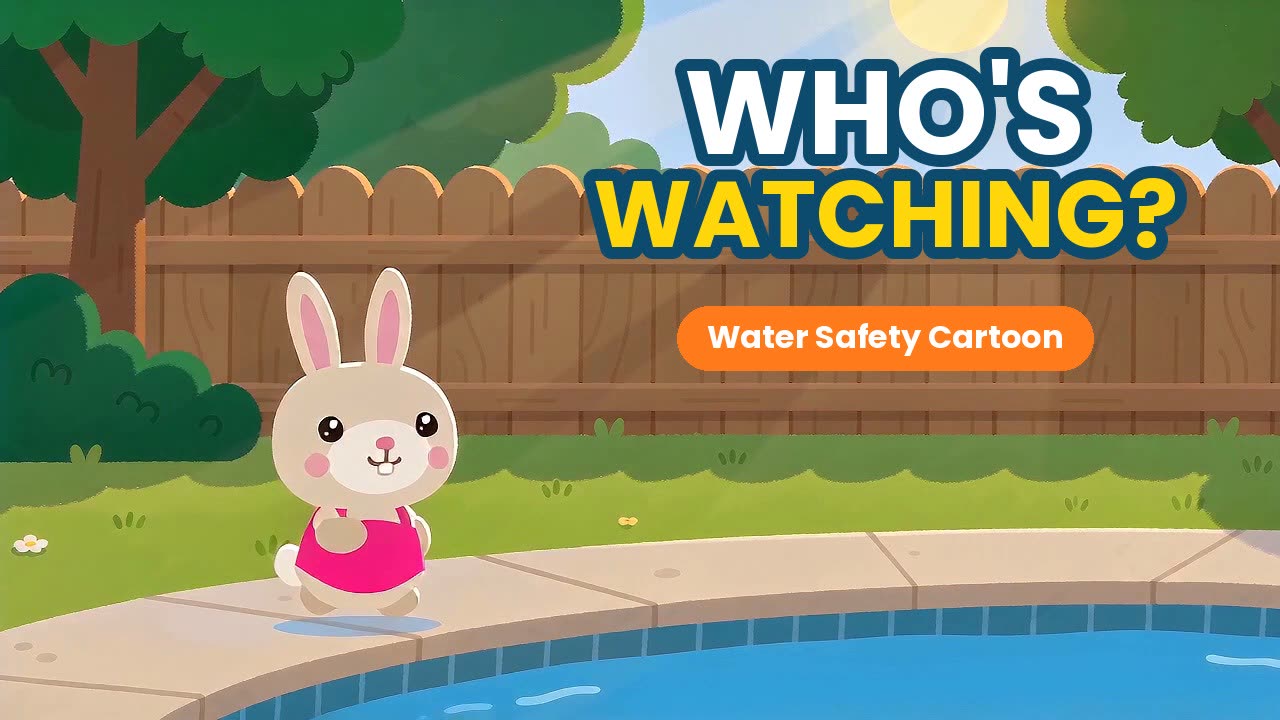
Runs 2 minutes 39 seconds, with captions. Made with AI animation tools and reviewed by people. See all our water safety cartoons.
👵🏻 Why do grandparents need a separate water safety checklist?
Grandparents often supervise grandchildren in unfamiliar settings, and CPR and drowning-prevention guidance have changed significantly, so a grandparent-specific checklist bridges the gap to current best practices. Grandparents are among the most important and most trusted caregivers in many families. They are also, statistically, more likely to supervise grandchildren in settings different from the child's daily routine — their own home, a summer cottage, a shared pool with a neighbor, a vacation rental at the beach. Each of these settings carries its own water risks, and each requires its own preparation.
There is another reason a grandparent-specific checklist helps: CPR technique and drowning-prevention science have evolved meaningfully over the past two decades. The "look up, reach down, pat the back" instinct that feels like common sense may not be the current recommended response. Floaties and water wings, once considered helpful, are now explicitly not recommended as safety devices. Backyard pool fencing standards, pool drain anti-entrapment requirements (Virginia Graeme Baker Act, signed 2007 and effective 2008), and best practices for supervision ratios have all been updated.
None of this suggests that grandparent supervision is less safe than parent supervision — often the opposite is true, given the patience and experience grandparents bring. But a short, explicit checklist bridges any gap between what grandparents already know and what the current best-practice guidance calls for. This page summarizes that guidance, and the printable checklist puts it on a single sheet of paper you can keep in the pool bag or on the refrigerator.
🚸 How should grandparents prepare before a visit?
Before any water is entered, ask the parents about each child's swim ability, learn their medical info, refresh your CPR, inspect the water environment, and keep water access locked by default. Most water safety incidents are decided before any water is entered. Preparation determines outcome more than reflex does. Use this pre-visit checklist every time grandchildren are coming to a home or joining a trip where water will be present.
Ask the parents about each child's swim ability — specifically. "They can swim" is not a useful answer. Ask for specifics: Can the child swim 25 yards unassisted? Can they float on their back? Are they comfortable submerging their face? Have they had swim lessons this year? Each answer changes how close you need to be and what equipment you need to have ready.
Know each child's medical information. Inhalers, EpiPens, seizure protocols, current medications, and allergies. Write it down and keep it accessible — not in your memory. The moment of an emergency is not the moment to try to remember which grandchild is allergic to bees.
Refresh your CPR certification. If your last CPR course was more than two years ago, your certification has expired under current standards. Sign up for a Red Cross, YMCA, or hospital-run class before the next visit. Child and infant CPR are separate skills and are typically covered in the same course as adult CPR. For a parent-level overview, see our guide to parent CPR and water rescue basics.
Inspect the water environment. Walk every pool fence, check every gate latch, test any pool alarm, confirm bathtub non-slip mats are in place. For visits to other homes or rentals, do this walk-through on arrival. A pool fence with a broken latch is worse than no fence at all, because it creates the illusion of a barrier.
Keep access off by default. Water access should be locked down except when you are actively supervising. Gate locked, bathroom door closed, hot tub covered. The grandchildren swim only during designated, supervised sessions. This default-off posture is the foundation of the "layers of protection" framework used by child safety experts.
👁️ What does active supervision look like during water time?
Active supervision means a designated Water Watcher keeps full, undistracted attention on the children — with touch supervision (within arm's reach) for any child under 5 or any non-swimmer. Active supervision means your full attention is on the children in the water. The CDC notes that most drownings of young children happen quickly and silently during brief supervision lapses. Not most of your attention. Not your peripheral attention while you check email. Full attention, for the entire duration of the swim session.
The practical tool that makes this possible is the Water Watcher role. The designated Water Watcher has one job: eyes on the water. No phone, no book, no simultaneous cooking or gardening, no side conversations with other adults. If you need a break, you pass the Water Watcher role explicitly and verbally to another adult before you disengage. Many families use a physical handoff item — a lanyard, a hat, a badge — so there is no ambiguity about who is on duty. For more on the Water Watcher system, see our family pool safety checklist.
For children under 5 and for non-swimmers of any age, supervision must be touch supervision: within arm's reach at all times. Watching a toddler from a deck chair ten feet away is not supervision for this age group. The drowning risk curve for children ages 1–4 is steep enough that every safety expert agrees on this rule.
A habit that costs nothing but dramatically improves supervision: count heads on a regular rhythm. Every 30 seconds if multiple children are in the water, say each child's name out loud as you confirm them. This prevents the "I thought you were watching" supervision gap that appears in a high percentage of drowning case reviews. Supervising twins or several young kids at once needs its own plan.
On alcohol: no drinks while on Water Watcher duty. Even one drink measurably slows reaction time. Save the glass of wine for after the children are out of the water and the pool gate is re-locked.
And remember what drowning actually looks like. It is silent — no splashing, no yelling. The child's head is low in the water, their eyes are often glassy or closed, their body is vertical, their arms paddle weakly. If you cannot see a child's face clearly for 10 seconds, check immediately. Nationally, drowning is the leading cause of unintentional injury death for children ages 1–4 — see our child drowning statistics dashboard for the numbers. For more, see our guide to the silent signs of drowning.
🧒 What are the age-specific water risks?
Each age group has a different water risk profile — bathtubs and buckets for infants, backyard pools for toddlers, overconfidence for school-age kids, and unsupervised open water for teens. Each age group has a different water risk profile. A supervision strategy that works for a 7-year-old is inadequate for a 2-year-old, and what works for a strong 12-year-old pool swimmer is inadequate for that same child in ocean surf.
Infants and babies under 1: Bathtub and bucket drownings are the primary risk. A baby can drown in less than an inch of water and in less than 30 seconds. Never leave an infant alone in any water — not to grab a towel, not to answer the phone, not for any reason. For more on this age group, see water safety for babies under one.
Toddlers (1–4): This is the highest-risk drowning age group in the United States. Backyard pools and unsecured water (ponds, buckets, bathtubs, decorative fountains) are the leading hazards. Four-sided isolation pool fencing with self-latching, self-closing gates reduces toddler drowning risk by approximately 50% compared to three-sided fencing that uses the house as one side. Door alarms and pool alarms provide an additional layer.
School-age children (5–9): Overconfidence is the primary risk. A child who swims a lap cleanly at the YMCA may be unprepared for open water, variable depth, or the fatigue that comes with sustained swimming. Reassess swim ability in each new environment — do not assume pool swim ability transfers to lake or ocean swimming.
Tweens and teens (10+): Risks shift toward unsupervised open-water swimming, peer-pressure diving (including into unknown depths), cold-water shock, and for older teens, alcohol. Rules, presence, and clear expectations still matter — even when the teen protests that they are competent swimmers. Competence and safety are not the same thing.
🆘 How should grandparents prepare for an emergency?
Keep a phone poolside, know the exact address, have rescue equipment within 30 seconds, follow "Reach, Throw, Don't Go," and call 911 and start CPR if a child is unresponsive. A rehearsed plan is a faster plan. The minutes between recognition of a problem and the start of rescue and CPR are the minutes that matter most.
Keep a phone poolside — not on silent. Not in your pocket across the yard, not inside the house, not on "do not disturb." A phone that cannot be reached and dialed in 10 seconds is not part of your safety system.
Know the address where you are. This is especially critical when visiting your grandchildren's home, a friend's pool, or a vacation rental. Write the full street address on a sticky note by the phone when you arrive. A 911 dispatcher cannot send help to a place you cannot describe.
Rescue equipment within 30 seconds. A reaching pole (at least 12 feet), a ring buoy with a throw rope, and a first-aid kit. For your home, mount them on the pool fence. For visits, ask the host where these are kept before children enter the water — or if no equipment is available, improvise by placing a long pool noodle and a large beach towel at the water's edge.
Remember Reach, Throw, Don't Go. First, reach from the deck with a pole, a towel, or your arm. Second, throw a flotation device. Only enter the water if you are a strong swimmer and you have a flotation device with you — an untrained rescuer drowning alongside the victim is a common and tragic outcome. For more on response, see what to do in a drowning emergency.
If the child is unresponsive and out of the water: Call 911 (or have someone call) and begin CPR if you are trained. Do not delay chest compressions to call the parents — call the parents only once professional help is on the way. For a parent-level overview of CPR technique and when it applies, see our CPR basics for parents.
After any near-miss or water inhalation, watch the child closely for the next 24 hours. Changes in breathing, persistent coughing, unusual fatigue, or irritability warrant a call to the pediatrician or a visit to urgent care. Secondary drowning and dry drowning are rare but real, and early attention matters. See our guide to secondary drowning and dry drowning for what to watch for.
🏊 How can grandparents support swim lessons?
Grandparents are often the quiet deciding vote on swim lessons — offering to pay for a session, driving to class, or attending opening day can be the tipping point for a family. Grandparents are often the quiet deciding vote on swim lesson enrollment. A grandparent who offers to pay for a session, drive the grandchild to the first lesson, or attend opening day as a sign of support can be the tipping point for a family that has been meaning to enroll but has not yet.
The case is strong: the American Academy of Pediatrics cites research estimating that formal swim lessons reduce drowning risk in children ages 1–4 by up to 88%. Lessons are one of the most effective single interventions a family can make, and they scale naturally as the child grows. For the research behind this, see what the AAP research actually says about infant swim lessons.
If your grandchild is not yet enrolled and you are looking to help, a few practical options: give a gift of a block of lessons for a birthday or holiday, drive the grandchild to and from class during summer, or attend the first session yourself to show support. Quality, safety-focused programs such as British Swim School and similar schools run year-round, often in warm-water environments that are especially good for reluctant beginners. For a broader view, see our guide on how to choose a swim school.
🖨️ Where can you get the free printable checklist?
The complete Grandparent Water Safety Checklist is available as a free, printable one-page reference covering pre-visit prep, supervision rules, age-specific risks, and emergency readiness. The complete Grandparent Water Safety Checklist is available as a free, printable one-page reference. Print it, tape it to the fridge, or save it to your phone as a PDF — and walk through the list before every visit where grandchildren will be near water.
The printable covers: pre-visit prep (CPR status, medical info, environmental inspection), active supervision rules (Water Watcher, touch supervision, no alcohol, head counts), age-specific risks (infant through teen), and emergency readiness (phone, address, rescue equipment, Reach/Throw/Don't Go, CPR).
→ View and print the free Grandparent Water Safety Checklist here
Or enter your email below to get the printable plus weekly water safety tips for families and caregivers.
📚 Authoritative Sources
- CDC — Drowning Facts: drowning is the leading cause of unintentional injury death for U.S. children ages 1–4, often during supervision lapses.
- American Academy of Pediatrics: touch supervision and formal swim lessons, citing research that links lessons to up to an 88% lower drowning risk for ages 1–4.
- American Heart Association — CPR: current CPR guidance and the importance of immediate bystander CPR.