In this guide (9 sections)
Hot tubs pose drowning and entrapment risks that many families underestimate. Our national drowning statistics report puts these hazards in the context of overall U.S. child drowning data.
Watch With Your Kids: The Hot Tub! Cartoon
Our cartoon shows how fast a hot tub can get to be too much for a small body. On a chilly night Gus turns the hot tub all the way up and says “let’s stay in as long as we want.” Little Ziggy is under five, so he stays out with a timer. Then Scout starts to feel funny, Tilly speaks up, and Gus gets him out right away and owns the mistake. Buoy the capybara explains the rule to say together: Hot tub? Five minutes, then out!
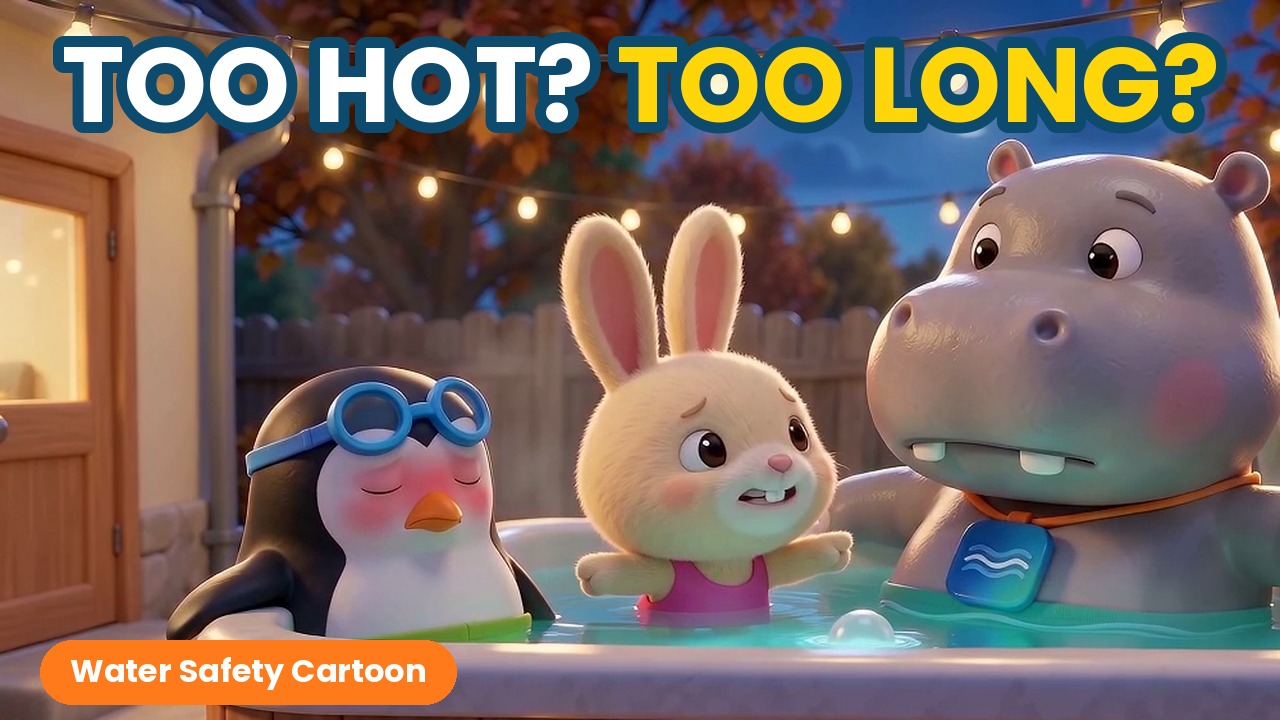
Runs 2 minutes 54 seconds, with captions. Made with AI animation tools and reviewed by people. See all our water safety cartoons.
Why are hot tubs more dangerous than pools for kids?
Hot tubs are more dangerous than pools for children because their elevated water temperature (typically 100°F to 104°F) can overheat a small body within minutes, while powerful suction drains add an entrapment hazard pools rarely match. A hot tub is not simply a warm, small pool. The elevated temperature — typically 100°F to 104°F (38°C to 40°C) — creates hazards that a standard swimming pool does not. And children's bodies respond to that heat very differently than adults do.
A child's body surface area is proportionally larger relative to their body mass than an adult's. This means they absorb heat from the water much faster. A child can reach a dangerous core body temperature in a fraction of the time it would take an adult at the same water temperature. The result: what feels pleasantly warm to a parent can be putting a child's body under serious heat stress within minutes.
Additionally, hot tubs typically feature powerful recirculation jets and suction drains. These create entrapment hazards that are far more serious than those in standard pools — the suction forces in hot tub drains have been documented trapping children and adults alike, holding them underwater.
What age can children safely use a hot tub?
Children under 5 should not use hot tubs at all, and children ages 5–12 should use them only briefly (5 minutes or less) in water below 100°F with direct adult supervision. The American Academy of Pediatrics (AAP) recommends that children under 5 years old should not use hot tubs. This is not an abundance of caution — it reflects the genuine physiological risk of rapid heat absorption in very young children.
For children ages 5 through 12, limited use is acceptable under strict conditions: water temperature must be set to 98°F or below (well under the typical adult maximum of 104°F), time in the water should be limited to 5 minutes or less per session, and direct adult supervision is mandatory. The supervising adult should be in or immediately beside the hot tub, not across the patio.
Teenagers can use hot tubs more like adults but should still avoid staying in for more than 15–20 minutes, stay well-hydrated, and exit immediately if they feel dizzy, lightheaded, or nauseous. These symptoms indicate heat stress that can progress quickly.
How quickly can a child overheat in a hot tub?
A child can reach dangerous heat stress within minutes, because their larger body-surface-to-mass ratio absorbs heat far faster than an adult's. Heat-related illness progresses in stages: heat cramps, heat exhaustion, and heat stroke. In children in hot tubs, this progression can happen faster than parents expect. The challenge is that the early stages of overheating — flushed skin, fatigue, reduced alertness — can be easily mistaken for a child simply being relaxed and happy in the warm water.
Warning signs that a child should exit the hot tub immediately include: red or flushed skin, dizziness or lightheadedness, complaints of headache, unusual quietness or sleepiness, nausea, or rapid breathing. If any of these appear, remove the child from the hot tub, move them to a cool area, and give them water to drink. If symptoms don't improve within a few minutes, seek medical attention.
Heat stroke — where the body's temperature regulation system fails entirely — is a medical emergency. Signs include confusion, loss of consciousness, and stopping sweating despite extreme heat. Call 911 immediately.
What is hot tub drain entrapment and how do you prevent it?
Drain entrapment happens when a spa's suction traps hair, clothing, or limbs underwater; prevent it by using compliant anti-entrapment drain covers and knowing where the pump shutoff is. Hot tub and spa drain entrapment is one of the most under-discussed hazards in residential pool safety. The suction from circulation system drains can trap hair (wrapping around the drain as it's pulled in), clothing (bikini bottoms, shorts), fingers, toes, and even limbs. The suction force can be powerful enough that even a strong adult cannot pull free without shutting off the pump.
The Virginia Graeme Baker Pool and Spa Safety Act (VGB Act), passed by Congress in 2007, requires all public pools and spas to have anti-entrapment drain covers that meet CPSC pool and spa safety standards. These covers are designed to reduce suction force and make entrapment physically impossible in most cases.
For residential hot tubs, homeowners should confirm that their drain covers meet current CPSC standards and replace them if they are cracked, missing, or out of date. Never use a hot tub with a missing or broken drain cover. Children with long hair should always have it secured up (in a bun or braid) before entering a spa. Loose clothing and dangling accessories should be removed.
If a child's hair or limb becomes entrapped in a hot tub drain, do not pull forcefully — this can cause serious injury. The immediate action is to cut the pump power at the circuit breaker. Know where your hot tub's emergency shutoff is before you ever turn it on with children present.
What water-chemistry hazards do hot tubs pose to children?
Warm spa water breeds bacteria like Pseudomonas and Legionella when chemicals are neglected, and children — who swallow more water — are especially vulnerable. Hot tubs require higher concentrations of sanitizing chemicals than pools because the warm water creates an environment where bacteria thrive. Pseudomonas aeruginosa — the bacteria responsible for "hot tub folliculitis" (a skin rash) — and Legionella (which causes Legionnaires' disease) are both common hot tub pathogens when chemical balance is neglected.
Children are more susceptible to both because their immune systems are still developing and they tend to swallow more water. Signs of hot tub folliculitis include an itchy, bumpy rash appearing 12–48 hours after hot tub use. It typically resolves on its own but should be evaluated by a pediatrician if it persists or is accompanied by fever.
Before children use any hot tub — especially at a hotel, rental property, or another household — test the water chemistry or ask the owner when it was last tested and balanced. Cloudy or malodorous water is a red flag indicating chemical imbalance.
How do you keep kids safe in hotel and rental hot tubs?
Treat unfamiliar hot tubs with extra caution: ask when the spa was last inspected and tested, check the drain cover and water clarity, and skip it if anything seems off. Vacation hot tubs introduce additional uncertainty. You don't know the maintenance history, when the water was last tested, or whether the drain covers meet current standards. This requires extra vigilance.
At hotels and resorts, ask staff when the spa was last inspected and the water last tested. A well-managed facility should have records. Look for a posted pool inspection certificate — most jurisdictions require these for commercial facilities.
At vacation rentals (Airbnb, VRBO, etc.), inspect the hot tub drain cover before your children use it, check the water clarity, and smell for unusual chemical odors. If anything seems off, skip the hot tub. No vacation memory is worth a preventable health or safety incident.
For general vacation water safety, see our comprehensive guide on vacation water safety for families and hotel pool safety tips.
What hot tub rules should families set at home?
Post clear, non-negotiable rules before children ever use a home hot tub: no kids under 5, a 98°F cap, a 5-minute limit, never alone, hair up, and a known emergency shutoff. If you have a home hot tub, establish clear, non-negotiable rules before children ever use it. Post these rules near the hot tub:
No children under 5 in the hot tub, ever. This should be an absolute household rule with no exceptions.
Maximum temperature 98°F when children are present. Keep a digital thermometer near the spa for easy checking before use.
Maximum 5 minutes per session for children under 12. Use a timer if needed — excited children won't self-regulate.
No child in the hot tub alone. An adult must be present and attentive at all times. This means not scrolling a phone on the other side of the deck.
Hair up, no loose clothing. All long hair must be secured. Remove any loose accessories or clothing before entry.
Know the emergency shutoff location. Every adult who supervises hot tub use must know where the pump shutoff is — at the unit and at the circuit breaker.
Hot tub locked when not in use. A locking cover that meets ASTM standards protects against both unsupervised access and accidental falls into the hot tub.
Why do hot tubs need locking covers and barriers?
A hot tub without a locking cover is an unsupervised water hazard; a hard ASTM-rated cover plus a perimeter barrier stops young children from reaching it in seconds. A hot tub without a locking cover is an unsupervised water hazard in your backyard. Young children who wander outside while adults are distracted can reach a hot tub in seconds. A hard, locking spa cover rated to ASTM standards prevents this entirely.
In addition to the cover, consider a perimeter barrier around your hot tub similar to what you would use for a pool. Many states have specific fencing and barrier requirements that apply to hot tubs and spas as well as pools. For state-specific requirements, see our guide on pool and spa fence requirements by state.
The five-layer protection model that water safety experts recommend for backyard pools applies equally to hot tubs: physical barriers, supervision, swimming skills, emergency response readiness, and a family water safety plan. Our five layers of drowning prevention guide details each layer in depth.
📚 Authoritative Sources
- CPSC — Pools & Spas: anti-entrapment drain-cover standards under the Virginia Graeme Baker Act.
- American Academy of Pediatrics: water-safety guidance for young children, including supervision and age limits.
- American Red Cross — Water Safety: layers of protection and CPR readiness around home water.