In this guide (8 sections)
What Are Pool Floaties — And What Aren't They?
Pool floaties are recreational toys, not safety devices — the American Academy of Pediatrics warns that air-filled or foam toys such as water wings and inflatable rings should never be used in place of a life jacket. Walk into any major retailer in summer and you will find a wall of inflatable pool products marketed to parents of young children: inflatable arm bands ("water wings"), ring buoys children sit in, inflatable vests with leg straps, and combination arm-and-chest floatation devices often called "puddle jumpers." These products are typically priced between $5 and $30, adorned with cartoon characters, and shelved directly beside actual USCG-approved life jackets.
The critical difference is printed in small text on every package: "This is not a life preserver" or "This is not a Coast Guard-approved personal flotation device." Manufacturers are legally required to include this warning — but it competes with packaging that uses words like "safety," "protection," and pictures of happy toddlers floating effortlessly.
What floaties are: recreational pool toys that provide some buoyancy support in supervised shallow-water play for children who are learning to feel comfortable in water. What floaties are not: devices that will keep a child alive in an emergency, work on open water, function if deflated or improperly positioned, or substitute for swimming ability or supervision.
Watch With Your Kids: Scout’s Super Floaties! Cartoon
Our cartoon shows why floaties are not a reason to look away. At an indoor pool, Scout shows off his new floaties and Gus sits down with a magazine: “Floaties on? Great. Then I can sit right here and relax.” Then one floatie slides off Scout’s slippery flipper. Scout grabs the wall, Tilly speaks up, and Gus gets him out right away and owns the mistake. Buoy the capybara explains the rule to say together: Floaties on? Eyes still on!
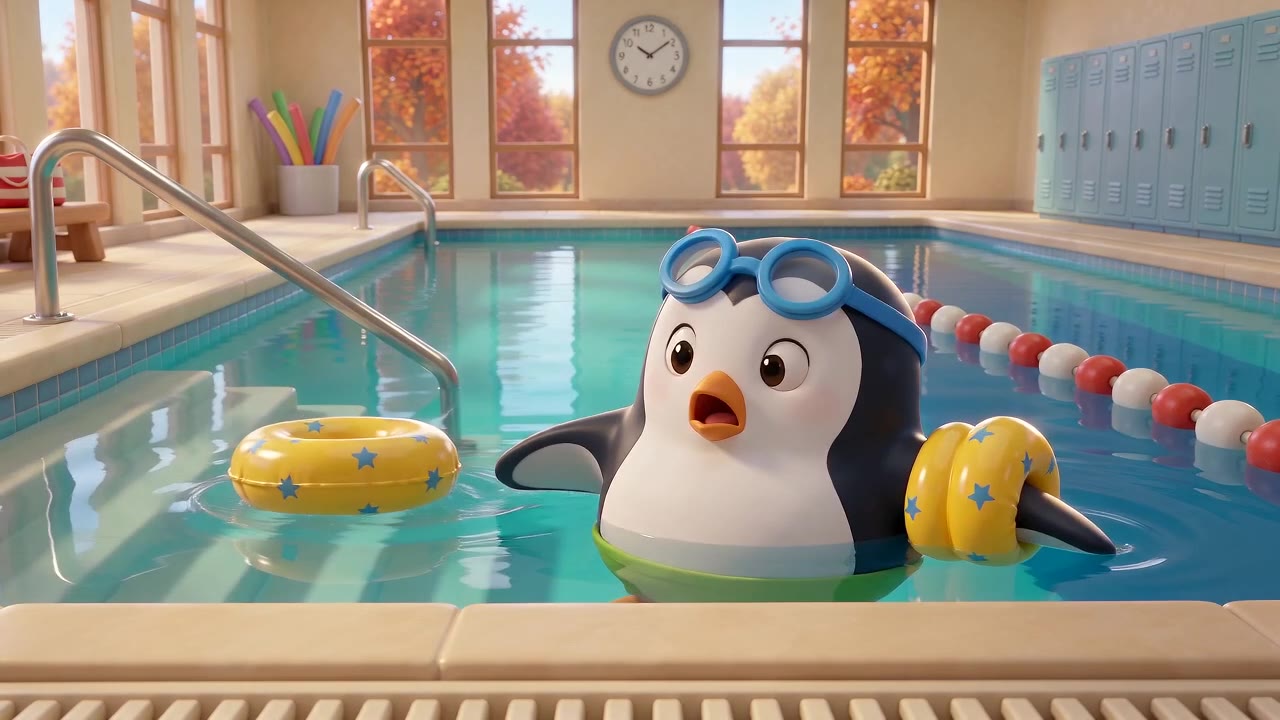
Runs 2 minutes 43 seconds, with captions. Made with AI animation tools and reviewed by people. For a quick list, see our floaties and puddle jumpers safety checklist or all our water safety cartoons.
What Are the Main Risks of Relying on Pool Floaties?
The four biggest risks are deflation or mechanical failure, dangerous body positioning, false confidence, and delayed swimming-skill development. Each one can turn a child who looks safe into a child in danger within seconds.
1. Deflation and Mechanical Failure
Inflatable products can fail. A puncture from a pool toy, a loose valve, or simple overuse can cause rapid or gradual deflation. Inflatable arm bands frequently slide down small children's arms or slip off entirely — particularly when a wet, excited child shakes their arm vigorously. A child who was buoyant one moment can be without support the next, with no warning to the parent watching from poolside.
2. Dangerous Body Positioning
Inflatable swim rings position a child's center of gravity above the ring. Lean too far forward, and the ring tips — flipping the child face-down in the water, with legs in the air and face submerged. This "tippy" dynamic has been implicated in pool drownings in which children were seemingly safe in a swim ring moments before going under. Even arm band floaties encourage children to lean their weight into the buoyancy, meaning an unexpected deflation leaves them with no recovery instinct.
3. False Confidence — The Most Dangerous Risk
This is the hidden danger that swim instructors cite most frequently. Children who use floaties for extended periods come to believe they can swim. They have spent hundreds of hours in water, moving their arms and legs, traveling from one end of the pool to the other — but the floaties were doing the work, not their bodies. When they enter water without the device, they have no functional swimming skill to fall back on. Water competency built through lessons is what protects kids; for the national picture on where and to whom drowning happens, see our child drowning statistics dashboard or our drowning statistics and facts guide.
The false confidence extends to parents as well. A child who has "been swimming" with floaties for two summers can seem water-competent. Parents may reduce supervision, allow deeper water access, or assume their child can handle a pool party unsupervised — when in reality the child cannot swim unassisted for even five meters. This gap between perceived and actual ability creates lethal conditions.
4. Delaying Real Skill Development
Children who spend their early water years in floaties develop muscle memory that works against actual swimming. Puddle jumpers, in particular, hold a child in a vertical body position — head up, legs down — that is the opposite of the horizontal position needed for freestyle or backstroke. Swim instructors report that children who have used puddle jumpers extensively for two or three years before starting formal lessons must "unlearn" habitual postures before they can develop real strokes. This sets their progression back significantly compared to children who began lessons without dependence on flotation aids.
What About Puddle Jumpers — Are They USCG-Approved?
Some puddle jumpers are USCG-approved Type III flotation devices, but that approval is limited to supervised pool use and does not make them a substitute for swim lessons or close supervision. This is one of the most common parent questions, and the answer requires nuance.
You can confirm a device's rating by checking for the U.S. Coast Guard approval label; the U.S. Coast Guard stresses that only approved, properly fitted life jackets are designed to keep a person's head above water. Many puddle jumpers — combination arm-wing and chest flotation devices — are listed as USCG-approved Type III personal flotation devices. This means they have passed Coast Guard testing for buoyancy in their approved category.
However, that approval comes with significant restrictions that are not prominently displayed on packaging:
- Approved only for supervised pool use — not open water, rivers, bays, or boating
- Sized for children 30–50 lbs only — outside that range, the device provides unreliable buoyancy
- Not designed to turn an unconscious child face-up — unlike Type I offshore life jackets
- Not a substitute for adult supervision within arm's reach
Even with USCG approval, puddle jumpers carry the swimming-skill-delay problem that all floaties share. Many swim instructor organizations recommend avoiding them and instead placing non-swimming children in proper USCG-approved life jackets when in or near water where they are not directly protected by an arm's-reach adult — and enrolling them in formal swim lessons as early as possible.
What Does a USCG-Approved Life Jacket Actually Do?
A USCG-approved life jacket is tested to keep a child's face above water even if they are unconscious or panicking — something no inflatable toy is designed to do. A properly fitted, USCG-approved Type I or Type II life jacket is engineered to do something no floatie can: keep a child's face out of the water even if the child is unconscious, panicking, or incapacitated. These devices are tested under strict federal standards, sized by weight (not age), and designed to self-right an unconscious wearer to face-up position.
For any activity near open water — lake swimming, beach play, boating, kayaking, dock fishing — a USCG-approved life jacket is the only appropriate device. Our complete life jacket guide covers how to fit and choose the right PFD for your child's weight and activity.
What Works Instead of Floaties — Do Swim Lessons Help?
Yes — formal swim lessons are the most effective alternative; the American Academy of Pediatrics cites research showing that swim lessons can reduce the risk of drowning by 88% among children ages 1–4. The only path to genuine water independence is learning to swim.
The American Academy of Pediatrics recommends swim lessons as a core layer of drowning prevention, alongside fencing and constant supervision. Children who have received formal swim instruction from a certified instructor can:
- Float on their back independently — the single most critical survival skill
- Swim to a wall or the shore when exhausted
- Roll from face-down to face-up without panicking
- Assess water depth and entry conditions before entering
- Call for help and signal distress
These skills take time — typically 1–3 years of consistent lessons to develop age-appropriate water independence — but they do not fail, deflate, slip off, or create false confidence. They are the child. Find accredited lessons near you at our swim lessons search.
Swimming is not the only protection — active supervision remains essential even for proficient child swimmers. But it is the irreplaceable foundation. No floatie teaches it, and no floatie replaces it.
How Can Parents Transition a Child Away From Floaties?
Transition gradually by starting swim lessons, practicing short floatie-free sessions in shallow water within arm's reach, and swapping floaties for a USCG-approved life jacket in deep or open water. If your child currently uses pool floaties and you want to begin transitioning to real safety practices, here is a realistic path:
Step 1: Enroll in formal swim lessons. This does not mean the floaties stop immediately — but lessons should begin. Let the instructor guide the transition.
Step 2: When not in lessons, practice supervised "floatie-free" time in shallow water (water at waist height for the child) with an adult within arm's reach. Short sessions — 5 to 10 minutes — build confidence without floaties in a safe setting.
Step 3: For any deep-water or open-water activity, replace floaties with a properly fitted, USCG-approved life jacket. This is not a step backward — it is the appropriate safety tool for those conditions.
Step 4: Celebrate milestone skills: first independent float, first swimming stroke, first trip across the shallow end. These skills belong to the child. Floaties should become something they have graduated from, not something they need.
For more guidance on building water confidence and healthy respect for water without fear, see our guide to teaching children to respect water.
What's the Bottom Line for Parents on Pool Floaties?
Floaties are fine as supervised shallow-water toys, but they are not safety devices and must never replace supervision, swim skills, or a USCG-approved life jacket. Pool floaties are not villainous products. Used appropriately — in shallow water, with an adult within arm's reach, as a comfort tool during the earliest stages of water exposure — they are relatively harmless. The danger is in what parents believe they provide: safety, independence, and drowning protection. They provide none of these things reliably.
The children who are safest in water are those who can swim, who are supervised by attentive adults, who know to call for help, and who understand the difference between safe and unsafe water conditions. Build those things. The floaties are optional. The skills and supervision are not.
📚 Authoritative Sources
- American Academy of Pediatrics (HealthyChildren.org): Explains that air-filled and foam toys like water wings are not safety devices and that swim lessons reduce drowning risk for young children.
- U.S. Coast Guard — Life Jacket Wear: Details how to choose and properly fit a Coast Guard-approved life jacket — the only flotation rated to keep a child's head above water.
- CDC Drowning Facts: Reports that drowning is the leading cause of unintentional injury death for children ages 1–4 and that supervision and barriers are essential.
- American Red Cross — Swim Lessons: Outlines how learning to swim builds the water-competency skills that flotation toys cannot provide.