In this guide (9 sections)
Watch With Your Kids: Nana Flo's Thirty Minutes Cartoon
Our 2-minute cartoon shows what the 30-minute rule gets wrong. Nana Flo makes everyone wait and watch the kitchen timer, and nobody watches little Ziggy. Buoy the capybara explains what keeps kids safe. The rule to say together: a grown-up watches, every time!
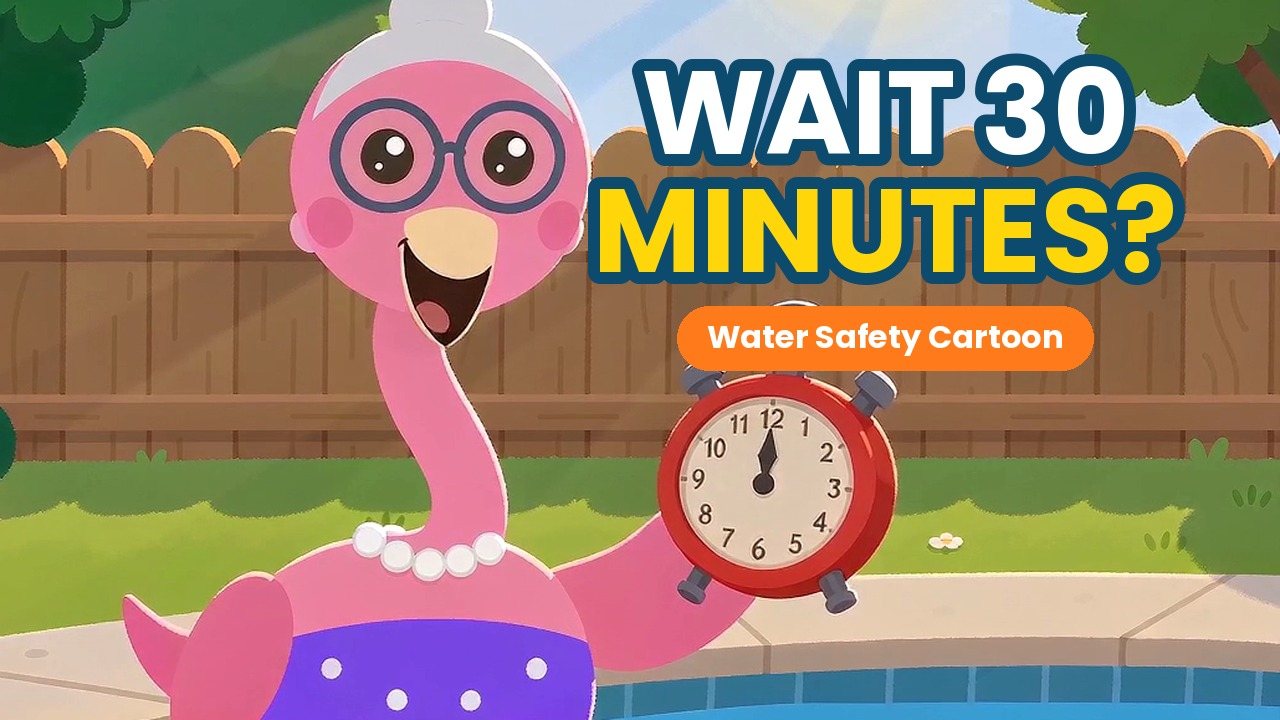
Runs 2 minutes 41 seconds, with captions. Made with AI animation tools and reviewed by people. See all our water safety cartoons.
Where did the "wait 30 minutes" rule come from?
The "wait 30 minutes" rule dates back over a century to early-1900s American parenting culture and a plausible-but-overstated idea that digestion diverts blood away from muscles. The myth has been circulating in American parenting culture for over a century. It appears in a 1908 Boy Scouts of America handbook — nearly identical to the version parents still repeat today. The warning was based on a plausible-sounding physiological argument: when you eat, your body diverts blood to the digestive system, leaving less blood available for working muscles. In theory, this could cause cramps severe enough to cause drowning.
Separating water-safety fact from myth is easier when you understand the real risks children face. Our drowning statistics report lays out the latest U.S. data by age group.
The idea sounds convincing because it contains a small kernel of truth — digestion does require increased blood flow to the gastrointestinal tract. But the human cardiovascular system is not a simple pipe with a fixed amount of blood to distribute. The heart compensates. The body is designed to handle simultaneous demands on circulation, including the mild demands of recreational swimming.
What does the medical evidence actually show?
The medical evidence shows no documented cases of drowning caused by post-meal swimming, and neither the American Red Cross nor the American Academy of Pediatrics lists meal timing as a drowning prevention measure. Researchers and physicians who have examined this question systematically find no support for the myth. A review published in the International Journal of Aquatic Research and Education found no documented cases in the medical literature of drowning caused by post-meal swimming. The American Red Cross and the American Academy of Pediatrics do not include post-meal waiting as a drowning prevention recommendation.
The physiological reality is that recreational swimming — the kind most children do at pools, lakes, and beaches — is not intense enough to create a dangerous competition between digestion and muscle function. Even competitive-level exercise does not "steal" enough blood from the gut to cause incapacitating cramps in healthy individuals.
What is true: vigorous exercise on a very full stomach can cause nausea, vomiting, or a side stitch — uncomfortable, sometimes even race-ending for a competitive athlete, but not a drowning risk in a supervised swim setting.
What actually causes swimming cramps?
Swimming cramps come from breathing mechanics, muscle fatigue, dehydration, electrolyte imbalance, or cold water — not from blood being diverted to digest food. The term "cramp" covers several distinct physiological events. Understanding what they are helps clarify why food is rarely the cause:
Side stitches (Exercise-Related Transient Abdominal Pain, ETAP): A sharp pain under the ribcage that occurs during exercise, most commonly believed to result from diaphragm irritation. Causes include breathing pattern, exercise intensity, and upward pressure from a full stomach — but the diaphragm cramping itself is not related to blood diversion. It is simply a muscle cramping from overuse or poor breathing mechanics.
Leg and calf cramps: These common swimmer cramps are primarily caused by muscle fatigue, dehydration, electrolyte imbalance (especially low potassium, sodium, or magnesium), or cold water causing muscle constriction. Food intake has essentially no direct relationship to leg cramps.
Abdominal cramps: Can result from swallowing water, cold water shock to the abdominal muscles, or — in rare cases — a very full stomach being jostled during intense exercise. These resolve quickly and do not cause swimmers to become unconscious or unable to float.
For a more detailed look at managing cramps in the water, see our guide to muscle cramps while swimming.
What genuinely causes childhood drowning?
The real drivers of childhood drowning are lack of supervision, inability to swim, missing life jackets, open water hazards, and unsecured pools — never meal timing. The persistence of the meal-timing myth is a small tragedy in water safety education — not because it harms children directly, but because it consumes parental attention that should be directed at the real drowning risks:
- Lack of adult supervision: The majority of childhood drowning deaths occur when a child slips away from supervision — often during a lapse of seconds to minutes. Active supervision (eyes on the child at all times while in or near water) is the single most powerful protective factor.
- Inability to swim: Children who cannot swim are dramatically overrepresented in drowning statistics. Formal swim lessons, beginning as early as age 1, are associated with significant reductions in drowning risk.
- Missing or improper personal flotation devices: Open water activities without properly fitted, USCG-approved life jackets account for a significant proportion of drowning deaths — especially in boating accidents.
- Open water hazards: Currents, cold water, entrapment by drains, and distance from shore create risks that no amount of digestion time mitigates.
- Pool barriers and fencing: Unsecured home pools are a leading site of toddler drowning. Four-sided isolation fencing with self-latching gates reduces drowning risk by approximately 83% (CDC).
What should kids eat before swimming?
For casual swimming, no special timing is needed; before intense training, allow 30–60 minutes after a snack or 1–2 hours after a large meal, favoring light, easily digestible carbohydrates. Even if the 30-minute rule is not a safety requirement, good nutrition before swimming does affect performance and comfort. Here is a practical framework for parents:
Before casual recreational swimming (no timing restriction needed): Regular meals and snacks are fine. If your child is wading, splashing, or playing in shallow water, there is no physiological concern about what they ate or when.
Before swim lessons or moderate exercise (light snack OK, large meal: 30–60 min): A banana, crackers, apple slices, or a small yogurt shortly before a lesson is fine for most children. A large meal within 30 minutes may cause mild nausea — not from blood diversion but simply from jostling a full stomach.
Before competitive swimming or intense training (1–2 hours after a substantial meal): For kids in competitive swim programs, coaches typically recommend allowing 1–2 hours after a significant meal before race or hard practice sets. This is about maximizing performance and avoiding vomiting at race pace, not about drowning prevention.
Best pre-swim snack foods: Easily digestible carbohydrates — banana, crackers, pretzels, a small amount of peanut butter, or half a granola bar. Avoid high-fat and high-fiber foods (fried foods, large amounts of beans, bran) before any water activity as these slow gastric emptying and are more likely to cause discomfort.
Hydration matters more than food timing: Children exercising in water lose fluid through sweat and respiration even though they are surrounded by water. Encourage water intake before, during breaks, and after any swimming session — especially on hot days.
How should you talk to kids about safety vs. myths?
Be clear about which rules are evidence-based safety rules and which are old habits, framing real rules around supervision, buddies, and life jackets rather than meal timing. One of the most valuable things parents can do for their children is be clear about which rules are safety rules and which are old habits. Children who understand the "why" behind real safety rules follow them more reliably and are better equipped to assess novel situations.
Instead of "wait 30 minutes or you'll get cramps and drown," consider: "You might feel a tummy ache if you swim hard right after a big lunch — let's take a rest and then jump in." This language is accurate, non-frightening, and helps children develop their own body awareness around exercise and eating.
Focus conversations about water safety on the genuinely life-saving rules: always swim with a buddy, always tell an adult before entering the water, always wear a life jacket in a boat, never swim alone. These rules have evidence behind them. The meal-timing rule does not.
Which water safety rules actually matter?
The rules that actually matter are swim lessons, active undistracted supervision, properly fitted life jackets on boats, four-sided pool fencing, and learning CPR. Parents who want to protect their children around water should focus energy on the interventions with the strongest evidence base:
- Enroll children in age-appropriate swim lessons — starting as early as age 1 year with parent-child classes
- Maintain active, undistracted supervision any time children are near water — phones away, eyes on kids
- Ensure all children in boats wear properly fitted, USCG-approved life jackets
- Install four-sided pool fencing with self-latching gates if you have a home pool
- Learn CPR — immediate bystander CPR significantly improves outcomes in drowning emergencies
These interventions save lives. The 30-minute meal rule does not — but replacing it with accurate information and real safety habits absolutely does.
📚 Authoritative Sources
- American Academy of Pediatrics: drowning prevention guidance — does not include post-meal waiting as a recommendation.
- American Red Cross — Water Safety: evidence-based water safety rules and supervision practices.
- CDC — Drowning Facts: four-sided isolation fencing reduces pool drowning risk by about 83%.
- U.S. Coast Guard — Life Jackets: properly fitted, USCG-approved life jackets for open water and boating.