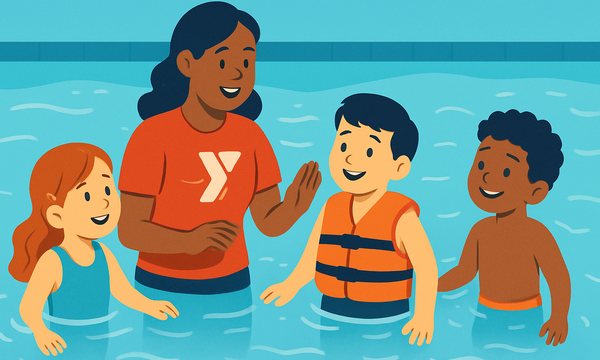
If cost has ever stood between your child and swim lessons, the YMCA's Safety Around Water program was built for exactly that gap. The Y — the nonprofit organization that helped invent modern group swim lessons more than a century ago — created Safety Around Water (often shortened to SAW) as a free or low-cost on-ramp to water competence. Drowning remains among the leading causes of unintentional injury death for children ages 1–4 in the United States, according to the CDC, and the American Academy of Pediatrics cites research showing that formal swim lessons are associated with an up to 88% lower drowning risk for children ages 1–4. The children most at risk are often those whose families never had access to lessons. SAW is the Y's answer to that disparity.
Below we break down what the program actually covers, how it differs from the Y's longer swim-lesson ladder, who qualifies, and the practical steps to get your child enrolled — especially during the summer drowning peak.
One frequently cited study found that participation in formal swim lessons was associated with an estimated 88% lower risk of drowning among children ages 1–4. Programs like Safety Around Water exist to put that protection within reach of every family. (Source: Brenner et al., published research on swim lessons and drowning risk.)
What is YMCA Safety Around Water?
Safety Around Water is a standardized national program offered through participating local YMCAs. Its guiding philosophy is summed up in three words: "Safety First, Swim Second." Rather than starting with stroke mechanics, SAW front-loads the skills that prevent a child from drowning in the first 30 seconds after they unexpectedly enter water — the moment that matters most.
Because the program is funded largely by charitable donations, corporate grants, and community partners, it can be offered at no cost or minimal cost to participants. That funding model is the whole point: the children who benefit most from water-safety skills are statistically the least likely to have paid for lessons, and SAW is designed to remove the price barrier entirely. The Y is a federation of roughly 2,600 independently operated branches, so the exact format, age ranges, and price differ from one location to the next, but the core curriculum is consistent.
What skills does Safety Around Water teach?
The program is built around two memorable skill sequences that even young children can recall under stress. Together they cover the two most common dangerous scenarios: falling in near an edge, and being too far from the wall to grab it.
1. Jump, Push, Turn, Grab. This sequence prepares a child for an accidental fall into the water close to the side of the pool or a dock. The child learns to jump in, push off the bottom or wall, turn back toward the point of entry, and grab the edge to pull themselves to safety. It is the self-rescue response for the most common backyard and public-pool fall scenario.
2. Swim, Float, Swim. This sequence is for deeper water, where grabbing an edge is not an option. The child learns to swim a short distance, roll onto their back to float and rest and breathe, then flip back over and continue swimming toward safety. Alternating swimming and floating lets a small child cover distance without exhausting themselves — the difference between reaching the wall and panicking.
Alongside these two core sequences, SAW lessons reinforce water-safety behaviors out of the pool, too: always swim with a buddy, ask permission before getting in, recognize that a life jacket is required in open water, and understand how to help someone in trouble without jumping in yourself (reach or throw, don't go). These habits are the same ones we detail in our complete drowning prevention guide.
How many lessons are in the program?
A standard Safety Around Water session typically runs about eight lessons spread over a week or two, adding up to roughly four hours of in-water time. Some branches deliver it as an intensive over consecutive days — popular right before summer — while others stretch it across a few weeks. Sessions are grouped by age and ability so a nervous five-year-old is not in the same group as a confident eleven-year-old.
Eight lessons is intentionally short. The aim is to move a child from no water safety to foundational water safety as efficiently as possible, then encourage families to continue with ongoing lessons. Skills fade without practice, so SAW is best understood as a starting line, not a finish line.
How is SAW different from regular YMCA swim lessons?
This is the most common point of confusion for parents. The Y runs two related but distinct things:
Safety Around Water is the short, donor-funded, survival-first program described above. The Y's standard swim-lesson curriculum is a longer, fee-based progression organized into three categories — Swim Starters (parent-and-child for the youngest), Swim Basics (the core water-competency stages every child should reach), and Swim Strokes (technique and endurance for more advanced swimmers). Those stages have their own naming conventions that we untangle in our guide to YMCA swim level names decoded.
In practice, many families use SAW as the free entry point, then roll into Swim Basics to keep building. If you are weighing the Y against a dedicated swim school, our comparison of the YMCA versus a private swim school walks through the trade-offs in price, ratios, and curriculum focus.
Who qualifies, and is it really free?
Eligibility is deliberately broad. Most participating Ys open Safety Around Water to community children roughly ages 3 to 17, and many prioritize school groups, summer-camp cohorts, and families who qualify for financial assistance. At a large share of branches the program is genuinely free; at others it carries a small fee that scales with income.
If your local Y charges for SAW or it is full for the season, you still have options. The Y's broader financial-aid program can subsidize regular lessons — we explain it in our breakdown of YMCA Open Doors swim lesson assistance. And there are many other routes to no-cost or reduced-cost instruction, which we keep current on our swim lesson scholarships and free-lesson resource page.
How do I enroll my child this summer?
Getting started is straightforward, and summer is the highest-demand window, so move early:
Step 1 — Find a participating Y. Not every branch runs Safety Around Water, so search your local YMCA's program schedule for "Safety Around Water" or "SAW," or call the front desk and ask directly.
Step 2 — Ask about cost and financial assistance. Confirm whether the session is free, and if not, ask about sliding-scale pricing or Open Doors assistance in the same conversation.
Step 3 — Match the session to your child's age and comfort. Be honest about whether your child is a true beginner; the right group placement makes the eight lessons far more effective.
Step 4 — Register early and plan to continue. Free summer sessions fill fast. Once SAW is done, look at the Y's Swim Basics stages or another local program so the skills do not fade. If you are still choosing a provider, our directory can help you find swim lessons near you.
Will Safety Around Water make my child a strong swimmer?
Honestly, no — and it is not designed to. Eight lessons are enough to teach a child what to do if they fall in and how to get to safety, but they are not enough to build polished freestyle, backstroke, or the endurance to swim a full lap. Think of SAW as defense: the skills that keep a child alive in an emergency. Building a confident, capable swimmer is offense, and that takes months of consistent practice through a full lesson progression.
That distinction matters because some parents complete a free safety program and reasonably assume the box is checked. In reality, the children who drown are frequently described by caregivers as "able to swim a little." A little is the danger zone. After SAW, the single most valuable thing you can do is keep your child in the water regularly — whether through the Y's Swim Basics stages, another local program, or simply supervised family swim time that reinforces floating and rolling. Pair that with the layered protections every aquatics organization recommends, and the eight free lessons become the foundation they were meant to be.
The bottom line for parents
YMCA Safety Around Water is one of the best-value water-safety resources in the country precisely because, for many families, it costs nothing. It will not turn your child into a stroke swimmer in eight lessons, and it does not replace the non-negotiables of layered protection — active adult supervision, four-sided pool fencing, and life jackets in open water. What it does do is give a child the core self-rescue skills that buy critical seconds, and it does so for the families who need it most. Treat it as the first rung on the ladder, then keep climbing.
📚 Authoritative Sources
- CDC — Drowning Facts: drowning is among the leading causes of unintentional injury death for U.S. children ages 1–4.
- American Academy of Pediatrics (HealthyChildren.org): cites research finding formal swim lessons are associated with an up to 88% lower drowning risk for children ages 1–4.
- USA Swimming Foundation: learn-to-swim access programs that address disparities in swim-lesson access.