In this guide (7 sections)
Watch With Your Kids: The Pool Is Closed! Cartoon
Our 2-minute cartoon shows why a closed pool still needs watching. Gus covers the pool for winter and relaxes, Scout decides the cover is an ice rink, and little Ziggy toddles straight for the puddle on top before Gus scoops him up. Buoy the capybara explains why a pool cover is not a floor. The rule to say together: Closed pool, still a pool!
Before you cover the pool, read why a child beneath the pool cover is in danger and which covers are safe. For above-ground pools, see what a pool safety cover can and cannot do.
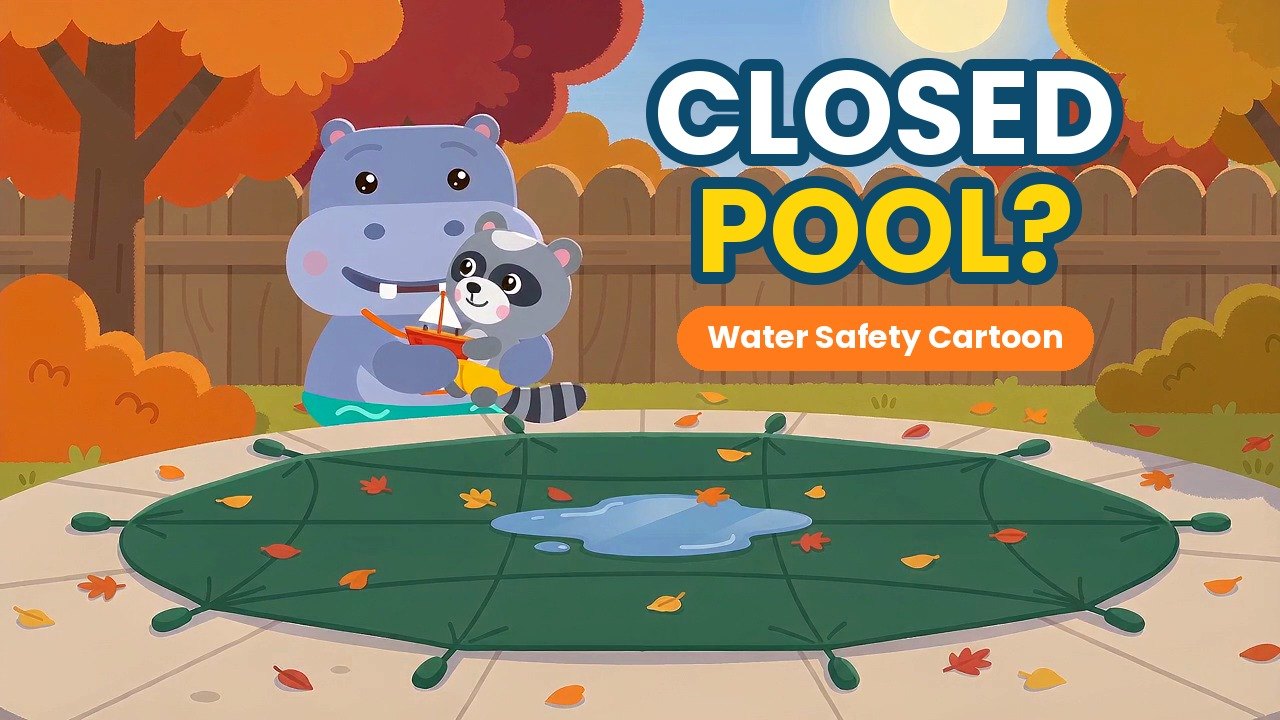
Runs 2 minutes 23 seconds, with captions. Made with AI animation tools and reviewed by people. See all our water safety cartoons.
⚠️ Is a closed pool still a drowning risk?
Yes — and in some ways the risk is higher, because the guard comes down. During swim season the pool is the center of attention: adults are nearby, eyes are on the water, rules are top of mind. Once it closes, all of that quietly switches off, but the water does not go anywhere. A toddler who wanders out a back door, a visiting child, or a family pet can reach a closed pool in seconds, and now there is no one watching. The CDC ranks drowning as the leading cause of death for children ages 1 to 4, and that risk does not follow the pool schedule.
There is a second, less obvious hazard that appears only after closing: standing water on top of the cover. Rain and melting snow collect on solid and loose covers, sometimes forming several inches of cold, murky water that a young child can drown in just as easily as in the pool below — while the cover hides them from view. Keeping a closed pool safe means treating it like an active hazard all winter, not a problem you have put away until June. Our layers of protection checklist explains why no single barrier is ever enough on its own.
🛡️ Safety cover vs. winter cover: what actually counts as a barrier?
Only an anchored safety cover is a barrier. A floating or tarp-style winter cover is not. The loose solid covers held down with water bags or clips are designed to keep leaves and debris out — they rest on or just above the water and will not hold a child's weight. A child or pet who steps onto one can slip underneath and become trapped, out of sight and out of reach. These covers have a real job, but keeping people out of the water is not it.
A true safety cover is stretched taut and anchored into the deck, built to hold significant weight and to shed water rather than pool it, meeting the ASTM F1346 safety-cover standard (CPSC Pool Safely). That is the only kind of cover that should ever be counted as a layer of protection — and even then, it works best alongside a fence and alarms, never as your only defense. If you are choosing new equipment this season, treat the safety cover and the fence as a pair, not either-or. Our family pool safety checklist covers how these layers fit together during the season, too. Closing is the second of the two weekends a year worth auditing the chemical shelf — our guide to storing and handling pool chemicals safely has the one-page version.
🔒 Keep the barriers working through the off-season
The fence, gate, and alarms that protected your family in July have to keep working every day through fall and winter. It is tempting to let maintenance slide once no one is swimming, but this is exactly when barriers matter most, because the human layer — active supervision — is at its lowest. Leave the four-sided isolation fence up, keep the gate self-closing and self-latching, and test it. Keep door and gate alarms powered, swapping in fresh batteries so a cold-weather drain does not silence them. Walk the perimeter for gaps, wobbly panels, or anything a determined toddler could climb. Our pool fence and gate inspection checklist gives you a repeatable way to check them.
Don't forget the above-ground and portable pools, which often get less attention than an in-ground pool but drown children every year. Remove or securely lock any ladder or steps so the water cannot be reached. For kiddie and inflatable pools, empty them completely, drain them, and store them upside down or deflated — a forgotten kiddie pool that refills with rainwater is a hidden hazard all its own. A designated water watcher still matters any time children are near a pool area, even a closed one.
🏊 The pool closed — but water risk didn't
Closing the backyard pool is the moment to keep swim skills alive, not shelve them. Water stays in a child's life all year — bathtubs, indoor hotel and gym pools, and holiday or spring-break travel to warm destinations all keep the risk present long after the cover goes on. And swimming is a perishable skill: a child who stops in September and returns the next June often slides back a level, relearning what they had already mastered. Our guide to why year-round swim lessons matter walks through how quickly that fade sets in.
The most protective response to a closing pool is to move to weekly, year-round lessons at an indoor, warm-water pool so skills keep building through the colder months. Our swim lesson frequency guide explains how often lessons need to happen to actually move a child forward, and many programs let you start with a free trial lesson to test the fit. Layered safety at home plus continuous skill-building is the combination that keeps children safest in every season — you can track that progress with our water competency skills checklist.
🖨️ Where can I get the free printable pool closing safety checklist?
You can view and print the free, one-page pool closing safety checklist below. It gathers the cover decision, the off-season barrier checks, the above-ground and kiddie-pool steps, and a fill-in family plan onto a single page you can stick on the fridge or in the garage — so a closed pool stays a safe pool until you open it again.
→ View and print the free pool closing safety checklist here
Or enter your email below to get the printable plus weekly water safety tips for families.
📚 Authoritative Sources
- CDC — Drowning Facts: National data ranking drowning as the leading cause of death for children ages 1–4, year-round.
- Pool Safely (U.S. CPSC): Federal water-safety campaign covering barriers, covers, and the layers-of-protection approach for home pools.
- American Academy of Pediatrics: Water safety guidance for children, including fencing, supervision, and swim-skill development.
- National Drowning Prevention Alliance: Layers of Protection framework — barriers, supervision, and swimming skills working together.